info@ecahli.com
+595 981 093 123
HQ: Asunción, Paraguay  ·  Flagship: Brazil
ECAHLI Kisumu, Kenya · African Flagship · In Partnership with CSTI · April 2026

Africa's Flagship
Integrated Low-Carbon
Node — Kisumu.

ECAHLI Kisumu is a phased, integrated low-carbon development in Kenya — combining quality housing, formal employment, healthcare, education, circular industry and regional logistics within one coordinated, MRV-accountable platform. Rooted in the Luo heartland of Lake Victoria, developed in partnership with CSTI, and structured for Kenya's green-building and climate-finance frameworks, the node is designed to demonstrate that decarbonised development is commercially viable in East Africa — and replicable across the continent.

This page presents the Kisumu flagship concept based on current node documentation and ECAHLI–CSTI partnership assumptions. All figures are indicative, subject to due diligence and final structuring.

Technical & Institutional Partners · Awards & Recognition
🇰🇪
Why Kisumu · April 2026

Kisumu: The Strategic
Anchor for Kenya's
Low-Carbon Flagship.

Kisumu has been selected as ECAHLI's African flagship city for its convergence of strategic logistics position, underserved community need, agricultural richness and climate finance potential. Located on the shores of Lake Victoria within Kenya's industrial and transport corridor, Kisumu sits at the heart of Luo territory — a region with documented, intergenerational knowledge of local soils, the lake system, and the seasonal rainfall patterns that govern agricultural cycles across western Kenya and into Homa Bay. ECAHLI treats that accumulated environmental intelligence as a practical complement to scientific monitoring and climate-resilience design: it informs how the node's agricultural systems, water management and early-warning indicators are structured, not simply how the project is described. ECAHLI, CSTI and local stakeholders are working together to develop Kisumu as a reference node for low-carbon, integrated community development across Kenya and the region.

Communities across Kisumu and Homa Bay have responded positively to the prospect of scientists, engineers and technical specialists choosing to live and work inside an integrated platform where housing, industry, agriculture, healthcare, education and circular systems are combined — a commitment that distinguishes this model from conventional project-based development.

Why Kisumu
Strategic regional logistics hub with road, rail and lake access to East and Central Africa
Significant housing, healthcare and education deficits — measurable need that the node is designed to address at scale
Rich agricultural base with strong agro-processing and cold-chain potential — informed by Luo knowledge of local land, seasonal cycles and the Lake Victoria ecosystem, which feeds directly into node design and MRV risk indicators
Measurable circular economy opportunity: recycling, e-mobility and cold-chain displacement of high-emission baselines
Climate finance eligibility aligned with Kenya's NDC commitments, green-building standards and national green growth framework
Node construction and operations designed to meet Kenya's green-building regulatory requirements and align with international zero-emission, efficient and resilient building networks
Clear replication pathway to Homa Bay and further nodes across Kenya and East Africa
CSTI partnership provides full MRV, credible DFI reporting, carbon baseline accountability, green-building certification pathway, climate finance structuring and technical services integration — translating global frameworks into practical local implementation
Interested in Partnering?

Investors, DFI institutions, development bodies, technical partners and sector operators are invited to engage with ECAHLI and CSTI on the Kisumu node opportunity. Early engagement shapes the structure.

Contact the ECAHLI Team ↗
KES 4.2–6.1B Indicative Node CapEx USD ~31–45M · Total development cost
KES 1.1–1.8B Annual Revenue Range USD ~8.1–13.3M / yr · At operational maturity
1,040–1,510 Direct Formal Jobs Statutory employment — green economy anchored
100 Homes — Community Ops Low-carbon residential zone
14+ Integrated Sectors One platform · Shared infrastructure
MRV-Ready Carbon Accountable Measurable baseline emissions reduction
CSTI Technical Partner MRV · DFI · Climate Finance · Green-Build
Kisumu African Flagship Node Kenya · East Africa · Replicable by Design
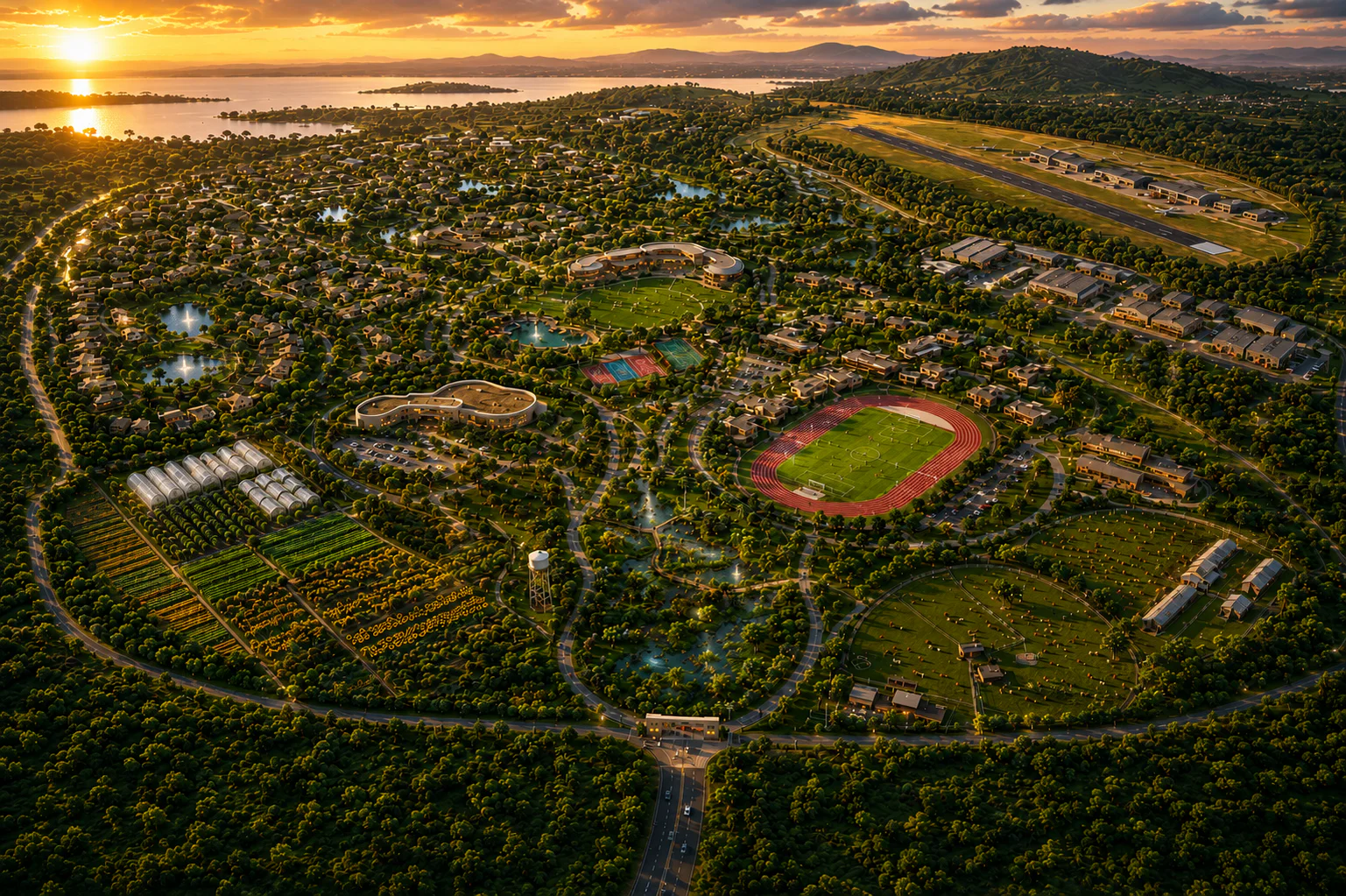
ECAHLI Kisumu — Dawn View over Lake Victoria, Luo Heartland, Kenya
Kisumu Flagship
Low-Carbon Residential Community — Dawn
ECAHLI Kisumu Residential Zone — Solar-Integrated Low-Carbon Housing
Residential
Solar-Integrated Community Housing
ECAHLI Kisumu Agriculture — Food Production Informed by Luo Seasonal Knowledge
Agriculture
Food Production & Agro-Processing Zone
ECAHLI Kisumu Low-Carbon Industrial Zone — Green Economy Employment
Industry
Low-Carbon Industrial Zone
ECAHLI Kisumu Aerial Platform View — Integrated Flagship Node
Flagship Vision
Kisumu Node — Integrated Platform
The Kisumu Vision

Low-Carbon.
Commercially Structured.
Built for Kenya.

ECAHLI Kisumu is a phased, integrated low-carbon development — combining an Anchor SPV, Impact Platform, Community Operations, Healthcare, Education and Aviation within one coordinated node. Every zone shares infrastructure, generates independent revenue and contributes measurable emissions reductions against a verified baseline. Developed in partnership with CSTI, the node is structured to demonstrate that emissions-reduction pathways and commercial returns can be built into a single development model — not treated as competing priorities.

Kisumu and the wider Homa Bay region sit within the Luo heartland of western Kenya — a community with detailed, intergenerational knowledge of local soils, the Lake Victoria basin, and the seasonal patterns that shape agriculture across this landscape. ECAHLI's agricultural design, water management and climate-resilience planning treat that knowledge as functional environmental data: it informs the design of risk indicators, irrigation and planting calendars, and early-warning thresholds alongside modern MRV methodology and climate-finance standards.

Low-carbon construction using CO₂-mineralised concrete, biochar-enhanced building materials and recycled-content systems runs throughout every structure, meeting Kenya's emerging green-building standards and designed for alignment with global zero-emission, efficient and resilient building networks. A solar microgrid powers the node. E-mobility logistics displace fossil-fuel transport. Closed-loop water systems and biodigesters close the resource cycle. Biochar and soil-carbon practices in agro-processing provide direct carbon dioxide removal (CDR) co-benefits. Every activity is measured against a credible emissions baseline, MRV-accountable and structured for DFI and climate finance alignment via CSTI.

  • Low-carbon construction throughout: CO₂-mineralised concrete, biochar-enhanced materials, recycled-content finishes — meeting Kenya's green-building standards and reducing embodied carbon from the ground up
  • Solar microgrid and e-mobility fleet displace grid power and fossil-fuel transport, delivering measurable scope-1 and scope-2 reductions against a verified baseline
  • Cold chain and agro-processing reduce post-harvest food loss and associated supply-chain emissions — with biochar and soil-carbon practices providing additional CDR co-benefits
  • Circular economy and recycling zones divert waste from landfill — quantified, MRV-accountable and carbon-registered via CSTI
  • CSTI provides full MRV, carbon accounting, DFI reporting alignment, green-building certification pathway, climate finance structuring, innovation support and network access — translating global frameworks into on-the-ground implementation
  • Node designed for alignment with global zero-emission, efficient and resilient building initiatives and international climate-finance networks
  • TVET training and green economy employment are designed to build local skills and enterprise capacity that generate public value across the wider Kisumu and Homa Bay region — not only for node members
  • Replication architecture to Homa Bay and beyond is built into the node model from phase one
Kisumu Node — Indicative Snapshot
Total node CapEx (indicative)KES 4.2–6.1B
USD ~31–45M
Annual revenue at maturityKES 1.1–1.8B
USD ~8.1–13.3M / yr
Direct formal jobs created1,040–1,510
Low-carbon homes — Community Ops100
Hospital — planned capacity50 beds
School + TVET campusIncluded
Phase 1 aviationIncluded
Integrated sectors and zones14+
Technical partnerCSTI

All figures are indicative, based on current Kisumu node documentation and ECAHLI–CSTI partnership assumptions. Subject to due diligence, site confirmation and final structuring. Figures in Kenya Shillings (KES); USD equivalents at approximate rate of KES 136 / USD.

The Kisumu Structural Advantage
Regional logistics hub (road, rail, lake)Strategic
Climate finance & DFI eligibilityDFI / Green
Kenya green-building standards alignmentCompliant
Healthcare & housing deficitCritical need
Agricultural & cold-chain productivityHigh
Multi-node replication pathwayHoma Bay +

Kisumu's convergence of logistics connectivity, Luo community knowledge, underserved need, agricultural richness and growing climate finance eligibility creates the conditions the ECAHLI integrated model is designed to address — at scale, commercially, with measurable decarbonisation outcomes against a verified baseline.

Why the African Flagship Matters

A Reference Model for
Low-Carbon Development
in East Africa.

Emissions & Livelihoods

The flagship is structured to show that emissions-reduction pathways — through low-carbon materials, circular value chains, renewable energy and soil carbon — can be built into affordable housing and formal employment from the outset. Decarbonisation and livelihood creation are designed as complementary outcomes, not trade-offs.

Green Industry & Affordable Live-Work

By integrating green construction materials, circular manufacturing and affordable live-work housing within a single platform, the Kisumu node demonstrates that green industrial development can serve local communities directly — rather than operating as an export-only or elite-only asset.

Local Communities & Global Networks

Through CSTI's technical partnership, the node is structured to connect Kisumu communities directly to global climate finance networks, green-building certification pathways and carbon registry frameworks. The purpose of that connectivity is concrete: local jobs, local skills, local enterprise and measurable climate outcomes — not institutional positioning alone.

A Replicable Model

Every design decision, financing structure and MRV framework in Kisumu is documented for replication. The node is intended to serve as a tested, de-risked template for subsequent nodes in Homa Bay and across Kenya and East Africa — a platform other regions and developers can adapt rather than reinvent.

Residential Membership

Live Here. Work Here.
Own This — Together.

Every Active Member of an ECAHLI flagship receives a comprehensive community life package — anchored in the Foundation's Articles, grounded in shared low-carbon infrastructure and documented co-ownership rights. Kisumu delivers this within an integrated economic platform, in a community where scientists, engineers, doctors, farmers and tradespeople choose to live alongside the people they serve.

Quality Low-Carbon Home

Homes built with CO₂-mineralised concrete, biochar-enhanced systems and recycled-content finishes — meeting Kenya's green-building standards. Solar-integrated, shared infrastructure, significantly reduced utility costs.

Healthcare — On-Site

Access to the planned 50-bed hospital, outpatient services and community health facilities — serving members and the wider Kisumu region. Air medical support linkage included.

Food via Agriculture & Agro-Processing

Grown, processed and preserved on-site. Fresh and value-added produce from the node's agricultural and cold-chain zones — designed around local seasonal cycles and regional crop systems, informed by Luo land knowledge and CSTI agro-science.

Education — School, TVET & Skills

On-site school, TVET and vocational programmes aligned with CSTI and Kenya's green economy priorities. Children educated locally. Adults trained for the low-carbon industrial transition — building skills and enterprise pathways that serve the wider community, not only node members.

Clean Energy, Water & Connectivity

Solar microgrid, closed-loop water systems, e-mobility infrastructure and fibre connectivity — all shared across the node. Significantly reduced reliance on unreliable or high-emission grid connections.

Formal Jobs — Close to Home

Statutory employment within the node across industry, services, healthcare, education and logistics. Green economy roles. Live-work proximity eliminates long commutes — reducing transport emissions and the income drain that commuter dependency creates.

Monthly Living Allowance

Every Active Member receives an equal monthly cash allowance in addition to employment income and shared infrastructure entitlements — a documented universal benefit of collective ownership.

Security, Ownership & Equal Vote

A planned, secure community. Every Active Member holds an equal co-ownership stake and an equal vote in community decisions — rights enshrined in the Foundation's constitutional Articles.

The ECAHLI Kisumu membership model delivers quality low-carbon housing, healthcare, education, food, clean energy and formal employment within a single, integrated community platform — collectively owned, equally governed, and designed to provide lasting security and opportunity for the current and next generation.

The same founding principles that define ECAHLI globally — co-ownership, equal vote, shared low-carbon infrastructure, long-term community rights — apply fully to the Kisumu flagship. Subject to final structuring and regulatory confirmation.

Apply for Residency ↗
The Economic Engine

14+ Integrated Sectors.
One Decarbonising Platform.

ECAHLI Kisumu generates income across structurally complementary sectors — industrial, community, healthcare, education and aviation — all sharing infrastructure, all delivering measurable emissions reductions against a verified baseline, and all structured for MRV accountability, Kenya green-building compliance and climate finance eligibility via CSTI. Integration is the source of both financial resilience and genuine impact.

Zone 1
Cold Chain & Warehousing

Temperature-controlled storage, logistics infrastructure and regional distribution. Reduces post-harvest food loss — a major source of food-system emissions in western Kenya — while building resilient agri-supply chain capacity. Solar-powered refrigeration and efficient equipment deliver operational emissions reductions against a grid-only baseline.

Industrial Anchor
Zone 2
Dairy, Preserved Foods & Agro-Processing

Dairy processing, preserved and packaged foods, agro-processing and value addition — drawing on regional Luo farming knowledge and Lake Victoria basin productivity. Biochar produced from processing residues is applied to linked smallholder plots for soil-carbon sequestration. Organic residues feed into the soil bank and green fertiliser supply chain, displacing synthetic inputs. A soil and seed bank cluster supports long-term soil health monitoring, seedbank infrastructure for regional crops, and — in later phases — options for broader genetic preservation linked to livestock and veterinary services.

Agro-Industrial · CDR
Zone 3
Low-Carbon Construction & Materials

CO₂-mineralised concrete, biochar building systems and recycled-content materials — meeting Kenya's green-building standards and reducing embodied carbon across every structure. The on-site construction materials hub supplies low-carbon blocks, panels and paving to all node zones, builds local green-construction skills and develops material supply capacity for Kenya's emerging CDR and low-carbon build sector.

Low-Carbon Build · CDR
Zone 4
Furniture, Steel & Technical Fabrication

Carpentry, CNC machining, steel fabrication and precision technical manufacturing. Timber and fibre inputs sourced from certified or recycled streams; off-cuts from other ECAHLI manufacturing lines are fed back into the workshop, closing a material loop within the node. Modular, repairable product design extends product life, and local production eliminates long-haul freight for bulky items.

Industrial Zone · Circular
Zone 5
Circular Economy & Recycling

Waste collection, sorting, processing and upcycling at scale. Diverts material from landfill, generates recycled-material revenue and delivers the node's most directly quantifiable emissions-reduction outcomes — plastic roads displacing virgin asphalt, recycled-content construction materials reducing embodied carbon. All fully MRV-accountable and carbon-registered via CSTI.

Circular · Carbon
Zone 6
E-Mobility & Logistics Services

Electric vehicle fleet, last-mile logistics and regional transport services powered by the node's solar microgrid. Integration with housing and industrial zones means most node workers commute by e-mobility rather than private combustion vehicles, delivering measurable scope-3 reductions for tenants and direct displacement of fossil-fuel transport across regional supply chains — verifiable and baseline-referenced.

Low-Emission Transport
Zone 7
Education, TVET & Green Economy Skills

School, vocational training and TVET programmes directly aligned with CSTI and Kenya's green economy priorities. Trains the skilled workforce that Kisumu's low-carbon industrial platform requires — and builds local enterprise capacity and public value across the wider Homa Bay and Kisumu region, not only within the node itself.

CSTI-Linked
Zone 8
Healthcare, Retirement & Community Services

50-bed hospital, outpatient, pharmacy and community health services. The primary healthcare anchor for Kisumu's underserved communities and node members. Solar-powered facilities with efficient building envelope design reduce energy-related emissions per patient against grid-only benchmarks. Integrated with Phase 1 aviation for air medical support and regional access.

Community Anchor
Zone 9
Phase 1 Aviation & Logistics Support

Licensed airstrip with air medical, cargo, executive aviation and drone logistics operations. Strengthens healthcare access, node connectivity and cold-chain logistics for high-value perishables. Efficient routing protocols and a sustainable aviation fuel (SAF) procurement pathway are built into operational planning, with CDR procurement linkage as the zone matures.

Phase 1 Aviation
Emissions-Reduction Pathways by Sector

How Each Sector
Reduces Emissions.

Each sector in the Kisumu node has a defined emissions-reduction pathway — through design, materials, energy, mobility, circular systems or soil carbon. These are not aspirational claims; they are structural features built into the node model and tracked via the CSTI MRV framework.

Affordable Live-Work / Mixed-Use Housing

Building envelopes are optimised for thermal performance through orientation, shading and insulation, reducing operational energy loads. CO₂-mineralised cement products and low-clinker blended binders from the on-site construction materials hub displace conventional Portland cement, lowering embodied carbon in structural slabs and walls. Onsite and district renewables supply remaining energy demand. Shared services and the live-work format itself reduce per-capita resource consumption and eliminate most commuting emissions at the household level.

Warehousing & Light Industry

Industrial sheds use efficient shell designs with daylighting and natural cross-ventilation wherever process requirements allow, reducing mechanical cooling loads. Rooftop solar PV on shed roofs feeds the node microgrid. Low-carbon blocks, panels and paving sourced from the ECAHLI construction materials hub displace conventional precast and fired-clay products. Energy-efficient refrigeration and motors in the cold-chain and dairy sectors cut operational emissions 30–40% against grid-only, grid-diesel baselines.

Agriculture & Agro-Processing

Biochar from processing residues is applied to linked smallholder plots, providing durable soil-carbon sequestration eligible for carbon-credit pre-finance. Agroforestry buffers on field margins add standing biomass and biodiversity co-benefits. Cold-chain equipment is right-sized, solar-assisted and co-located with production to minimise post-harvest losses and spoilage emissions. Organic residues cycle back into the soil bank and fertiliser distribution chain, displacing synthetic nitrogen inputs. The soil and seed bank cluster anchors long-term soil health monitoring and seedbank infrastructure as a climate resilience foundation.

Furniture & Interiors

Timber and fibre inputs are sourced from certified or recycled streams; off-cuts from other ECAHLI manufacturing lines feed the furniture workshop, closing a material loop within the node. Modular, repairable product design extends product life and reduces replacement demand. Low-VOC adhesives and finishes eliminate solvent emissions at point of manufacture. Local production and delivery shorten supply chains and eliminate long-haul freight for bulky items.

Green & E-Mobility Services

Electric two- and three-wheelers, electric shuttle buses and feeder services aligned with the Kisumu County Sustainable Mobility Plan replace fossil-fuel commuting for most node workers. EV charging is co-located with the solar microgrid, ensuring vehicles run on renewable-sourced electricity and delivering measurable scope-3 reductions for industrial tenants. Where aviation operations are retained for medical evacuation and logistics, efficient routing protocols and a structured SAF procurement pathway are built into the operational plan from day one.

Annual Revenue (at maturity)
KES 1.1–1.8B
USD ~8.1–13.3M / yr
Total Node CapEx (indicative)
KES 4.2–6.1B
USD ~31–45M
Direct Formal Jobs Created
1,040–1,510
Emissions Baseline, MRV & Green-Building

Every sector is designed to deliver measurable, verifiable emissions reductions — including direct carbon dioxide removal (CDR) pathways in agriculture, agro-processing and construction materials — against a credible baseline. MRV-accountable, Kenya green-building compliant, climate finance-eligible and aligned with global zero-emission building networks through CSTI. Decarbonisation is structural, not supplementary.

Development Programme

Phased Implementation.
Replicable by Design.

ECAHLI Kisumu is structured as a phased implementation — from baseline establishment and partnership formalisation through to full industrial and community operations, healthcare, education and multi-node replication. Each phase is designed to unlock the next, and every milestone is MRV-accountable and Kenya green-building compliant from the outset.

Phase 1 · Foundation
Due Diligence, Partnership & Baseline Establishment

Site confirmation, environmental and emissions baseline established — integrating both CSTI scientific methodology and Luo community knowledge of local land conditions, seasonal cycles and ecological indicators as complementary inputs to the MRV framework and risk indicator design. Full MRV framework agreed with CSTI. Kenya green-building compliance pathway confirmed. ECAHLI–CSTI partnership formally structured. Sector lead pairings confirmed. Capital structure closed. Regulatory pathway confirmed (NEMA, county government, Kenya civil aviation authority).

Phase 2 · Anchor Build
Industrial Anchor, Early Housing & Core Infrastructure

Cold chain, agro-processing and circular economy zones commissioned. First housing units completed using low-carbon construction systems — CO₂-mineralised concrete, biochar materials, recycled-content finishes — meeting Kenya's green-building standards. Solar microgrid live. E-mobility fleet operational. Closed-loop water systems and biodigesters installed. Soil and seed bank infrastructure established. Baseline emissions monitoring begins.

Phase 3 · Community Operations
Healthcare, Education, Services & Full Housing

50-bed hospital opens. School and TVET campus fully operational. Community services live across all zones. Remaining residential units complete. All node sectors revenue-generating. Full MRV carbon accounting active and reporting to CSTI. Climate finance documentation prepared for DFI engagement. Green-building certification documentation submitted for relevant international networks.

Phase 4 · Replication & Scaling
Multi-Node Expansion — Homa Bay & Beyond

Kisumu node at full operations, generating commercial returns and verified carbon outcomes. The Kisumu model — tested, documented and de-risked — is deployed to Homa Bay as the second node, building on the deep agricultural, ecological and community knowledge of the wider Luo region and Lake Victoria basin. Replication framework then offered to additional locations across Kenya and East Africa as a structured, proven template for low-carbon integrated development.

"Low-carbon housing, formal jobs, circular industry, healthcare and education — built together on Luo land, measured against a credible baseline, structured for commercial returns in Kisumu first. Then replicated across Africa."

ECAHLI Foundation · Kisumu African Flagship · In Partnership with CSTI · April 2026
Be Part of This

Invest. Partner. Join.
Help Build Kisumu.

Whether you are an investor evaluating the Kisumu node opportunity, a technical or institutional partner aligned with low-carbon development, a DFI or climate fund exploring East Africa, or an individual ready to live and work in the flagship — the window to engage and shape this development is open now. This is a node where technical specialists choose to live alongside the communities they serve, where local communities hold genuine co-ownership, and where every sector is structured to deliver both commercial returns and measurable emissions-reduction outcomes.

For Investors, DFIs & Operators

The Kisumu node is structured for DFI, impact and commercial investor participation across industrial, housing, services and climate finance revenue streams. Indicative CapEx KES 4.2–6.1B (USD ~31–45M). Full MRV, Kenya green-building compliance and DFI reporting alignment via CSTI. Designed for compatibility with international climate-finance networks and green-building certification pathways. Request the investor brief for details.

View Investment ROI ↗
For Technical & Institutional Partners

ECAHLI and CSTI invite alignment from climate funds, DFIs, universities, research bodies, green-building certification networks and sector technical partners. CSTI provides technical depth, climate and green-building standards alignment, innovation support and network access — translating global frameworks into practical implementation that generates local jobs, skills, enterprise opportunities and public value across Kisumu and the wider region. MRV co-development, carbon registry alignment and technical services integration are open for discussion.

Contact ECAHLI ↗
For Future Residents & Members

Register your interest in Kisumu residency now. Quality low-carbon homes, formal jobs, healthcare, education and genuine community co-ownership — built together, owned together, designed to give the current and next generation lasting security and opportunity. Founding member applications open as the node progresses through development phases.

Register Interest ↗

info@ecahli.com  ·  ecahli.com  ·  All enquiries treated with strict confidentiality

ECAHLI Kisumu, Kenya · African Flagship Node · Luo Heartland · In Partnership with CSTI · ECAHLI Foundation · Dutch Stichting · Netherlands · Flagship 1: Brazil · Goiás State · All figures indicative: subject to due diligence and final structuring · April 2026 · ecahli.com
ECAHLI Footer