Resources▾
Leadership▾
Projects▾
Invest▾
Work With Us▾

A global network of eco-community nodes combining housing, work, health, education, food systems, and climate action into one governed platform. Kisumu is the principal African flagship. Brazil, Paraguay, and future nodes follow the same template.
Impact is generated as a direct output of the commercial model — not a separate CSR layer bolted on after the fact.
The ECAHLI node makes money precisely by solving the structural deficits development institutions and governments have failed to close at scale — housing, healthcare, education, food systems, employment, ecological restoration, and waste management. Every revenue stream exists because a real human need is being met.
200 Wandiga eco-homes in Phase 1, growing to 1,400+ residents by Year 10 — funded by the same capital stack that delivers investor returns.
395 direct FTEs at Year 5, growing to 480 at platform maturity, all at 2.5× Kenya minimum wage. A clear path from entry-level to leadership.
280 farming families formally integrated into value chains by Year 5, with cold chain access and predictable purchase agreements.
15,000 patients served per year at Year 5, rising to 20,000 at Year 10 — a fee-for-service model that also improves community health outcomes.
200 TVET students per year, trained in skills directly matched to the node's enterprise zones. Lifelong learning embedded in governance.
25,000 tCO₂e removed or avoided per year. 480 tonnes of plastic diverted from Lake Victoria annually. Carbon is a revenue stream.
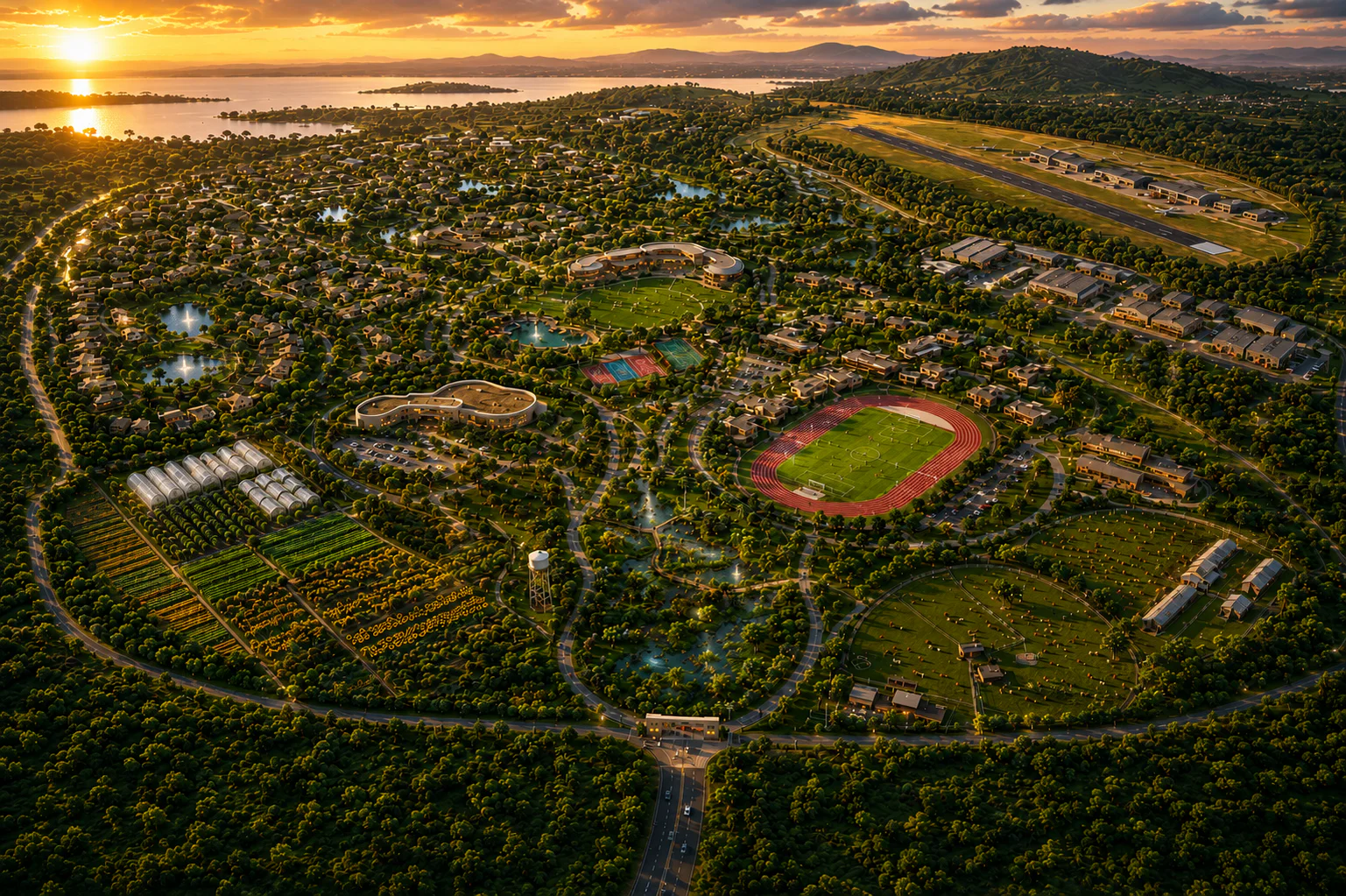
Every hectare generates both commercial return and measurable community impact.
All figures are derived from the ECAHLI Kisumu Financial Model v30 and Business Plan v30 (May 2026). They represent base-case modelled outcomes, not guarantees. Actual results may differ.
The ECAHLI employment model does not create casual, dependent, or paternalistic jobs. It creates formal employment at wages that allow people to save, invest, and build financial autonomy.


Each of the three pillars of social infrastructure is a fully operational zone — generating revenue, creating employment, and delivering measurable development outcomes simultaneously. This is not charity architecture. It is a funded, governed system.
The hospital does not run as a cost centre — it is a revenue-generating facility. Social outcomes are financially supported, not financially sacrificed.
Hospital: fee-for-service model, open to the wider Kisumu County community. TVET: tuition income from external students alongside community cohorts. Wandiga homes: sales, lease options, and membership income. All three zones also create direct employment and supply-chain demand — with a governance framework that protects community access even as commercial revenue grows.
ECAHLI Kisumu treats environmental performance as a revenue-generating operational layer, not a compliance obligation. Every tonne of carbon avoided is monitored, verified, and monetised.
MRV-verified and ITMO-eligible under Kenya's NDC. Institutional-grade carbon revenue from Day 1. SDG 13 aligned.
Campus-wide solar microgrid with battery storage and biogas backup. Surplus generation available for grid export.
Collected from Lake Victoria, processed into recycled-content construction materials including road surfaces. SDG 12 aligned.
Agricultural and food-processing waste composted and returned to the farm — closing the circular loop.
Ecosystem restoration and biodiversity corridors at the Aluora lakeshore site. SDG 15 aligned.
MRV-verified carbon credits eligible under Kenya's Article 6.2 bilateral agreements. Included in the high-case scenario.
Designed for full energy independence at operational maturity — solar, biogas, battery storage from the masterplan stage.
Movement IV expansion modules introduce hempcrete and recycled-aggregate manufacturing on-campus.

480 tonnes of plastic diverted from Lake Victoria — turned into road surfaces and building materials.
The ECAHLI Kisumu node generates demonstrable progress across ten UN Sustainable Development Goals as a direct, auditable output of its commercial operations — not a separate reporting exercise.
280+ farming families linked into formal value chains; estimated USD 1,740/year income uplift per farmer by Year 5.
USD 1,740/farmer/year upliftIntegrated food systems producing fresh, affordable food on-campus for 600–1,400+ residents.
600+ residents food-secure by Y5On-campus healthcare facility serving 15,000 patients/year by Year 5 — open to residents and wider Kisumu County.
15,000 patients/year · Y5200 TVET students per year trained in skills aligned to real node roles. On-campus schooling for residents' children.
200 TVET graduates/year395 direct FTEs at Year 5, all at 2.5× Kenya minimum wage. Formal contracts and structured training paths.
395 direct jobs · 2.5× min wage200 Wandiga eco-homes in Phase 1, growing to 1,400+ residents by Year 10. Green infrastructure by design.
200 homes · 1,400+ residents Y10480 tonnes of plastic diverted per year; 143 tonnes of organic waste composted annually.
480t plastic diverted/year25,000 tCO₂e per year removed or avoided. MRV-verified, ITMO-eligible carbon credits aligned with Kenya's NDC.
25,000 tCO₂e avoided/year52,000 native plants per year for Aluora lakeshore restoration and biodiversity corridors.
52,000 native plants/yearInstitutional relationships with UNEP, IFC, AfDB, GCF, County Government of Kisumu, CSTI Kenya, and IRSA.
UNEP · IFC · AfDB · GCF · CSTIECAHLI is being built as a replicable node architecture, with a long-term strategic ambition of approximately 50 nodes per continent over 20 years, subject to local readiness, partnerships, and governance conditions.
150–500 hectares, 7+ integrated zones, 30+ revenue streams, 395–480 direct FTEs at maturity, and a governed community of 600–1,400+ residents. Kisumu is the first African node at full scale.
Multiple nodes in a region share supply chains, knowledge systems, and institutional relationships. Kisumu and the Aluora Makare Border Hub pilot node form the first Kenyan cluster.
A network of nodes and clusters across a continent, governed under the ECAHLI Global Holdings stewardship architecture. Each node is a replicable blueprint, not a bespoke project starting from zero.
"Kisumu is not a pilot. It is not a concept. It is the first proof that a governed, self-sustaining, integrated community can be built in Africa — and that it can generate the returns serious capital requires while delivering what communities have always deserved. This is the model. And it is ready now."

The same team delivering Kisumu today is the template for every node that follows.
ECAHLI provides auditable, model-derived impact metrics aligned with DFI and ESG reporting needs. The Kisumu base-case metrics — 395 direct jobs, 25,000 tCO₂e, 15,000 patients, 200 homes, 280 farmers formalised — are available for institutional review with full financial model and methodology documentation. Brazil and other nodes are aligned on the same framework.
All figures from ECAHLI Kisumu Financial Model v30 and Business Plan v30 (May 2026). All metrics represent modelled base-case outputs. They are not guarantees of future performance. Full methodology and risk disclosures available on request to verified institutional investors and ESG partners.
Eco-Community Alternative Housing Lifestyle Initiative — a living, working, self-sustainable community platform where people have everything they need to flourish, governed by the ECAHLI Community Handbook and built for a 50-year horizon.
Investor and partnership inquiries reach the founding team directly — no call centre, no delay.
© 2026 ECAHLI. All rights reserved.