Resources▾
Leadership▾
Projects▾
Invest▾
Work With Us▾
ECAHLI's Kenya network is taking shape — the African Flagship, six Regional Nodes planned nationally, Tiwi Bay Heights eco-resort, the Tsavo conservation initiative, and Malindi Ngomeni Eco Coast. Not a single project. A continental development platform, being built in stages. Expressions of interest are open now.
Our aim: 450 homes occupied. 1,975 jobs active. 30+ revenue streams running. A self-sustaining community economy — governed permanently, designed for zero dependency on aid.
Figures reflect ECAHLI's internal financial and impact modelling. They are illustrative projections, not a forecast of actual results — full models available to qualified investors on request.

The ECAHLI Kenya network isn't one project — it's five interconnected development platforms, each proving and multiplying the model as it advances.
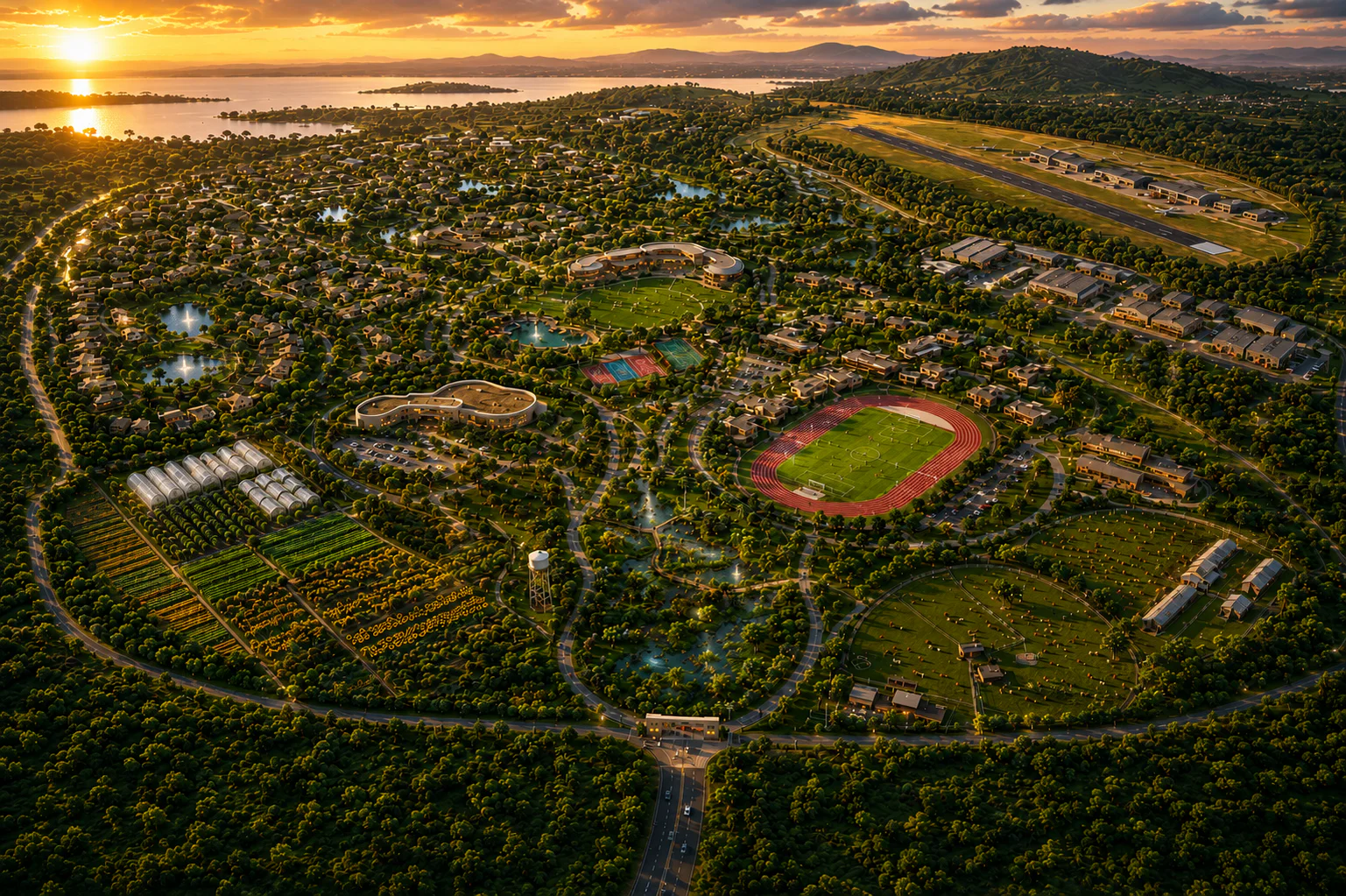
450ha integrated eco-community. Modelled at 1,975 jobs and 30+ revenue streams. Seven zones operating as one.
Planned across Kenya. Smaller scale, faster execution — each proving the model and multiplying impact.
25-acre beachfront eco-resort. Premium hospitality anchor and institutional gateway to the network.
Conservation and community development. Ecological stewardship. Carbon revenue. Regional anchor.
42 acres of owned freehold beachfront. Circular economy platform — hospitality, senior living, agriculture, and renewable energy.
ECAHLI seeks countries and partners who share this model's long-term view. Kenya has been an early and committed partner, anchoring the first Flagship under active development in Africa, with a broader regional pipeline to follow.
Strategic governance alignment. Active, deepening dialogue with AfDB, IFC, and the World Bank over recent months. Strong NDC climate commitments. All five platforms in various stages of planning and delivery, targeting simultaneous operation by 2028.
Brazil — Goiás State: modelled ~USD 78.1M CapEx, ~555 jobs, ~27.4% projected IRR. Paraguay — La Colmena & Gran Chaco: the first live demonstration, targeted for 2027/2028.
Spain — European Flagship: rural regeneration in advanced negotiations under the REDR framework and "España renovada" vision. Portugal is under consideration as ECAHLI Global Holdings' future European operational base.
The Flagship is designed to combine housing, healthcare, education, employment, agriculture, circular industry, and environmental stewardship as one governed, interdependent platform — where the output of one zone becomes the input of the next.

Modelled at 200 TVET students trained annually in skills aligned to real Node employment — a direct pathway from education to career, without migration.
450 homes planned — 250 main node with freehold options, 200 affordable — solar-powered, low-carbon.
Full healthcare designed to serve a modelled 15,000 patients per year, open to residents and the wider region.
Modelled at 280 farmers in structured supply relationships. Greenhouse production, livestock, agro-processing — value retained locally.
Modelled at 480 tonnes of plastic diverted annually. 25,000 tCO₂e avoided, MRV-verified. Waste streams designed to become revenue.
Hotel, conference facilities, restaurant, and aviation infrastructure — revenue designed to cross-subsidise training.
Most development addresses one or two of these. ECAHLI is designed to address all four simultaneously — not as a convenience, but because genuine resilience is difficult without each one. Figures below are modelled projections, not yet delivered results.
Solar-powered. Low-carbon. Freehold title options. A home here is designed to be a stake in a community governed by residents, not just shelter.
Formal supply agreements are designed to retain value locally through cold chain and agro-processing. Produce is planned to feed the hospital, school, restaurant, and regional market.
395 permanent direct roles planned. 45 SMEs. 280 farmers. A TVET campus designed to produce graduates for jobs inside the Node.
Seven zones, thirty-plus modelled revenue streams. Design target: no stream exceeds 25% of Year 5 output. Carbon revenue verified for the current MRV cycle.

The Flagship is designed to generate measurable impact across all three dimensions simultaneously — not trade-offs, but improvement built into the architecture from Day 1. Figures below are modelled unless otherwise noted.
Money, skills, and enterprise are designed to circulate within the host economy. Farmers gain access to formal markets. Graduates gain access to employment.
Carbon avoided is monitored, verified, and monetised for the current MRV cycle — an operational revenue layer, not just a compliance obligation.
Social impact is measured by the conditions created for people to govern their own lives with dignity, as participants in a constitutionally governed system.
Structured for blended finance — built to meet DFI standards, impact investors, and institutional capital. The financial model is complete; the governance architecture is being finalized. A small number of T1 equity positions remain for founding investors.
All figures modelled across candidate regions, based on current assumptions. Not a forecast of actual results. Location-specific model issued post-confirmation. Full model and risk disclosures available to verified investors on request.
Three global awards recognized ECAHLI's vision and community model before the first Node entered construction — external validation the vision is being taken seriously, not a technical audit of the model itself.
Acquisition International · 2025
Global Recognition · 2025
CorporateLiveWire Global Awards · 2025/26
"Kenya isn't receiving a single project. It's the anchor for five integrated development platforms — a Flagship proving the model, six Regional Nodes designed to multiply it, Tiwi Bay Heights anchoring institutional capital, Tsavo demonstrating conservation at scale, and Malindi extending the network along the coast. The ecosystem is designed to work as one. The work is under way, and Kenya's transformation is the vision we're building toward."
Understand the model, the opportunity, and whether your capital, institution, or nation is the right fit for the African Flagship. The conversation costs nothing — what comes after it is where the work begins.
Eco-Community Alternative Housing Lifestyle Initiative — a living, working, self-sustainable community platform where people have everything they need to flourish, governed by the ECAHLI Community Handbook and built for a 50-year horizon.
Investor and partnership inquiries reach the founding team directly — no call centre, no delay.
© 2026 ECAHLI. All rights reserved.
Eco-Community Alternative Housing Lifestyle Initiative — a living, working, self-sustainable community platform where people have everything they need to flourish, governed by the ECAHLI Community Handbook and built for a 50-year horizon.
Investor and partnership inquiries reach the founding team directly — no call centre, no delay.
© 2026 ECAHLI. All rights reserved.