Resources▾
Leadership▾
Projects▾
Invest▾
Work With Us▾
The machines aren’t coming. They’re already here — and they’re reshaping every industry, every economy, and every life on the planet. This is not a drill. This is the defining moment of our generation.

Imagine waking up one day to find that the skills you spent years — even decades — developing are now performed by a machine in seconds, for a fraction of the cost. For millions of IT professionals around the world, that moment is not hypothetical. It is already happening.
Artificial intelligence is transforming the technology sector with breathtaking speed. Code that once took development teams weeks to build can now be generated in minutes. Complex debugging sessions that kept senior engineers at their desks through the night are being resolved in a blink. Entire layers of IT infrastructure — from database administration to systems analysis, from cybersecurity monitoring to software testing — are being automated at a pace no one predicted even five years ago.
The numbers tell a story that should make every professional sit up and take notice.
Goldman Sachs has warned that AI could replace the equivalent of 300 million full-time jobs globally, potentially replacing a quarter of all work tasks in the US and Europe. The World Economic Forum’s Future of Jobs Report 2025 paints an equally striking picture: approximately 22% of current jobs will transform significantly by 2030. While around 170 million new job opportunities will emerge — primarily in technology-driven sectors, green industries, and care services — about 92 million existing roles are projected to disappear.
In the tech sector specifically, the impact is already measurable and accelerating. In the first six months of 2025 alone, nearly 78,000 tech job losses were directly attributed to AI. The tech sector is at the forefront of cuts, with 89,251 job cuts reported within the first seven months of 2025 — a 36% increase from the same period in 2024.
This is not a distant forecast. This is happening now.
The IT industry built its dominance on a simple premise: technical complexity creates job security. If you could write code, architect systems, or solve network problems, you had a career for life. That premise is now being fundamentally challenged.
According to ARXIV research, 80% of the US workforce might see at least 10% of their job tasks affected by large language models. For IT workers in particular, the exposure is even more direct. AI tools now write production-ready code, generate documentation, perform automated testing, handle network monitoring, and even design architecture recommendations — tasks that once justified entire departments and six-figure salaries.
Hiring in the tech sector has declined drastically, with jobs announced in 2025 representing a 58% decrease from 2024. Companies are not replacing the workers they let go. They are replacing entire functions.
More than a third of companies using AI say that the technology replaced workers in their organization because “they were no longer needed.” And the trajectory is only steepening. The World Economic Forum suggests that more than 7.5 million data entry jobs will be eliminated by 2027, marking the largest anticipated job loss in any single profession.
The velocity of this shift is unprecedented. Previous technological revolutions — the industrial age, the internet boom — unfolded over decades, giving societies time to adapt. AI is compressing that timeline to years, even months.
Here is where it gets particularly revealing: even the most powerful institutional investors in the world are re-evaluating their positions.
BlackRock — the world’s largest asset manager, overseeing more than $11 trillion in assets and holding significant stakes in virtually every major IT company on earth — is publicly signalling a strategic pivot. Just a fifth of those polled by BlackRock say large US technology firms remain a compelling investment for the coming year. By contrast, 54% of respondents consider energy providers to be a stronger opportunity, and 37% say energy infrastructure offers a better outlook than the big tech sector.
Consulting leader Gartner estimates that capital expenditure on AI hit US$1.5 trillion in 2025 — a figure that worries investors concerned about concentration risk and uncertain returns, particularly when higher interest rates make borrowing more expensive.
The investment community is not abandoning AI — they are pivoting around it. The gold rush is shifting from the picks-and-shovels of software to the infrastructure and energy systems that power AI itself. Growing scrutiny of data centre profitability, with power bills rising continuously, is increasing pressure to identify sustainable, long-term value.
The message from the world’s smartest money is clear: the era of blind tech investment is over. A new era of infrastructure, sustainability, and real-world production is beginning.
The AI disruption does not exist in a vacuum. It is crashing into an already fragile global economy, and the collision is dangerous.
Global growth is forecast to slow to 2.3% in 2025, slipping below the 2.5% threshold often associated with a global recession. Trade policy uncertainty has reached historic highs, eroding business confidence and reshaping global trade patterns. Manufacturers and investors are delaying decisions, reassessing supply chains, and stepping up risk management efforts.
In early 2025, the Economic Policy Uncertainty Index reached its highest levels this century. Markets saw sharp corrections and significant losses, with the financial “fear index” reaching its third-highest level on record, behind only the peaks during the COVID-19 pandemic and the 2008 global financial crisis.
Conflict is accelerating the crisis. The World Economic Forum identifies state-based armed conflict as one of the top risks for 2025, with ongoing conflicts in Ukraine, the Middle East, and Sudan amplifying global uncertainty well beyond 2025. Fiscal priorities are shifting: official development assistance has dropped an estimated 18% from major donors between 2023 and 2025, with defence budgets rising as social spending shrinks.
The developing world is bearing the sharpest edge of this crisis. More than one quarter of emerging market and developing economies still have per capita incomes below pre-pandemic levels, while the average growth rate of this decade is expected to be the lowest since the 1960s.
We are witnessing a perfect storm: AI eliminating traditional livelihoods, geopolitical conflict destabilising economies, institutional investors retreating from legacy sectors, and billions of people in the developing world left with too little support and too few options.
Something has to change. And it has to change now.
The instinct when faced with a technological earthquake of this magnitude is to panic. To fight back. To resist. But history teaches us a different lesson: those who survive disruption are not those who cling to the past — they are those who find a new path forward faster than everyone else.
Alongside technological growth, the green transition is expected to create numerous new roles in renewable energy and sustainability sectors. The World Economic Forum predicts a 30% increase in professional agricultural roles by 2028 — equal to 30 million jobs — driven by the need for in-person manual labour and shorter supply chains.
The future belongs not to those who build the most sophisticated algorithms, but to those who build the most resilient, sustainable, and human-centred communities.
This is where ECAHLI enters the conversation — not as a utopian dream, but as a practical, scalable, and urgently needed solution.

ECAHLI — the Eco-Community Alternative Housing Lifestyle Initiative — was born from a simple but radical idea: what if we could build communities that don’t just survive the coming disruptions, but thrive independently of them?
ECAHLI’s mission is to transform currently underdeveloped rural areas into beautiful, functional communities, utilising state-of-the-art eco-technologies, creative income-generating ideas, and advancements in sustainable product development.
ECAHLI is not just a housing project. It is a complete, self-sustaining economic ecosystem — the world’s most comprehensive response to the multi-crisis we are now living through. ECAHLI was recognised as the Self-Sustainable Community Winner 2025, a testament to its revolutionary approach and real-world impact.
Each ECAHLI community is designed to be completely off-grid, producing its own renewable energy, growing its own food using advanced sustainable agriculture and tower farming technologies, processing its own raw materials into organic products, and offering free housing, free education, and free adult training and development to every community member.
In a world where McKinsey estimates that by 2030, 14% of the workforce — equating to 375 million workers — will need to shift careers due to AI impacts, ECAHLI provides exactly the kind of transition pathway those workers need: real skills, real work, real shelter, and a real future.
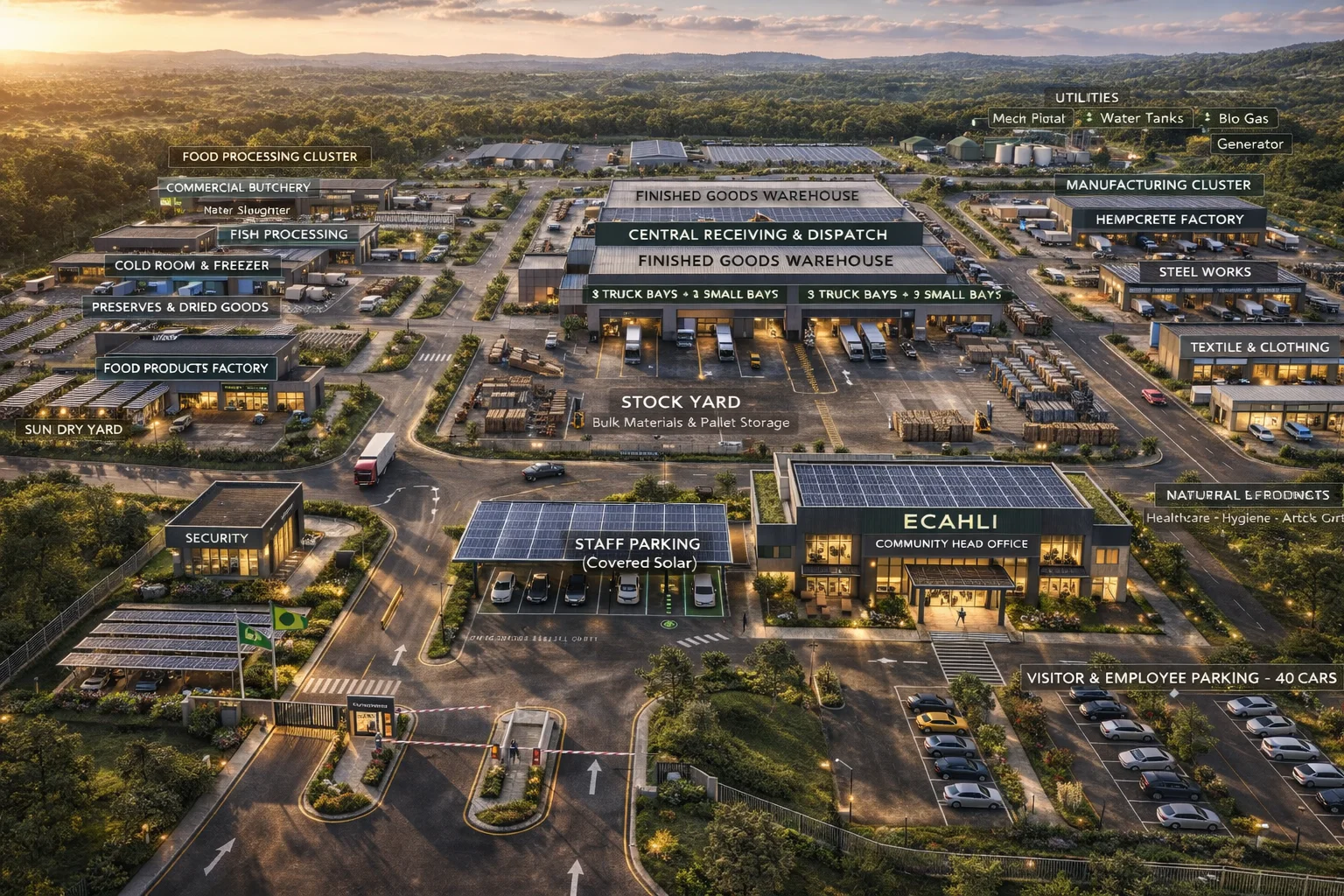
A single ECAHLI community development directly provides:
ECAHLI’s humanitarian initiative works to relocate, resettle, and rebuild the lives of community members in rural, population-deprived locations on substantial undeveloped land, working side by side with new members and surrounding local communities.
Every person living within the community receives free housing that meets the needs of themselves and their family, in modern eco-designed homes built to inspire and offer a healthy living area. People joining the community also receive free accommodation, work opportunities, free training and development, free education, and free meals, with endless opportunities for growth.
This is not charity. This is civilisational redesign.
One of the most powerful and underappreciated aspects of the ECAHLI model is its deliberate focus on the developing world. By choosing to build ECAHLI communities in rural, underdeveloped, and industry-deprived areas — in countries such as Paraguay, Panama, and beyond — ECAHLI is not just helping individuals. It is catalysing entire regional economies.
The ECAHLI model brings new economic opportunities to rural economies and infrastructure, and local governments welcome the project as it brings much-needed work opportunities and new economic development to areas that have long been overlooked.
In a world where trade among developing countries is expanding faster than other trade flows and now accounts for about one-third of global trade, ECAHLI communities become engines of exactly this kind of South-South economic growth. They produce organic, sustainable goods. They develop skilled workforces. They build infrastructure. They create exportable products in sectors where global demand is surging.
The ecovillage model has global precedent. The Global Ecovillage Network, founded in 1995, today encompasses over 1,100 villages worldwide, with communities of 50–350 people living in sustainable environments. ECAHLI builds on this proven framework but scales it dramatically, integrating modern eco-technology, commercial agricultural production, industrial transformation, and a comprehensive social services model that no previous initiative has attempted at this level.
ECAHLI is not building a community. It is building a blueprint for a new economic model — one that can be replicated, scaled, and adapted across every continent on earth.
For investors navigating the most uncertain economic landscape in living memory, the ECAHLI model represents something increasingly rare: a tangible, productive, and genuinely sustainable asset base.
Consider the investment environment: nearly seven in ten business leaders now rank a recession scenario as most likely for the world economy in 2025–2026, with the largest share citing a demand-led recession in which rising uncertainty causes consumer confidence to drop.
In this environment, what performs? Real assets. Food security. Energy independence. Organic production. Community resilience. These are precisely what ECAHLI delivers — not as aspirations, but as operational realities embedded in the community’s daily functioning.
BlackRock’s own research shows investors are pivoting toward companies that supply and sustain real infrastructure, driven by the recognition that sustainable, long-term value creation cannot rest on digital speculation alone. ECAHLI represents the natural extension of this logic into the physical world: communities that grow food, produce goods, generate energy, and support human life entirely on their own terms.
The global organic food market, the renewable energy sector, and the sustainable building materials industry are all experiencing dramatic growth precisely because the world is waking up to the fragility of systems built on fossil fuels, chemical agriculture, and centralised supply chains. ECAHLI sits at the intersection of all three.
There is a certain kind of work that AI cannot do. It cannot grow an organic crop. It cannot raise a child with love and wisdom. It cannot care for an elderly person with dignity. It cannot build a community from the ground up with human hands and shared purpose. It cannot look a neighbour in the eye and say: “We are in this together.”
These are not weaknesses. These are the foundations of civilisation — and they are exactly what ECAHLI is built upon.
The world is changing faster than at any point in human history. Entire industries are being reshaped. Livelihoods that took generations to build are being dissolved in months. Governments and institutions are struggling to keep pace. The old social contracts — work hard, follow the rules, and you will be secure — are fraying at every seam.
ECAHLI offers something different: a new contract. One built on equality, community, sustainability, and genuine human dignity. A place where no one is left behind. Where children inherit not debt and instability, but skills, land, and a living community of people who care for one another.
By working together in ECAHLI’s business initiatives, profits are shared fairly among all members of the community — ensuring that the wealth generated by collective effort is returned to the people who create it.
This is the answer to the age of AI. Not resistance. Not despair. But the deliberate construction of communities that are resilient by design, human by nature, and sustainable by necessity.
History does not wait for the comfortable. It rewards the courageous — those who see the turning of an age not as a catastrophe, but as an invitation.
We are living through the turning of an age. The IT sector that defined economic ambition for a generation is being restructured by machines. The global economy is groaning under the weight of war, debt, and geopolitical fracture. And billions of people across the developing world are waiting — not for handouts, but for genuine opportunity.
ECAHLI is that opportunity. It is the model that proves sustainability is not just environmentally responsible — it is economically essential. It is the proof that communities built on solidarity, organic production, and human purpose can not only survive the coming disruptions, but lead the world into what comes next.
The choice before us is not between the old economy and AI. It is between building something that endures — and watching something collapse.
Build something that endures.
Build ECAHLI.
For more information about the ECAHLI Initiative, investment opportunities, and community development projects, visit ecahli.com.
Eco-Community Alternative Housing Lifestyle Initiative — a living, working, self-sustainable community platform where people have everything they need to flourish, governed by the ECAHLI Community Handbook and built for a 50-year horizon.
Investor and partnership inquiries reach the founding team directly — no call centre, no delay.
© 2026 ECAHLI. All rights reserved.