Resources▾
Leadership▾
Projects▾
Invest▾
Work With Us▾
One replicable node architecture. Two ways to deploy it. Unlimited futures to rebuild.
Across Spain, Italy, Portugal, Latvia, and much of rural Asia, thousands of towns and villages are quietly emptying out — losing their young people, their services, and their economic reason to exist. Culture and heritage survive on postcards, but they cannot sustain young families, generate formal employment, or hold a community together without an economic engine.
They aren't leaving because they lack talent, ambition, or attachment to their heritage — they're leaving because the old model no longer provides jobs, services, or resilience for young families.
Culture and community do not disappear because people stop caring. They disappear because there is no longer an economic engine underneath them. When the last employer closes, the last school merges, and the last doctor retires, the architecture becomes a museum and the community becomes a memory.
ECAHLI Nodes are designed to reverse this decline — not by preserving the past in amber, but by building a new economic operating system underneath existing communities, or creating thriving new ones where the land is available and the opportunity is right.
Seasonal, low-paid, mono-sector economies cannot absorb shocks or attract young professionals.
Buildings, energy grids, and water systems grow disproportionately expensive to maintain as populations shrink.
Historic streets and traditions retain aesthetic value but cannot alone sustain young families or fund services.
The same land could host regenerative agriculture and circular manufacturing — what's missing is a governed framework to deploy it.

Heritage intact. Economic engine gone. Young people absent.

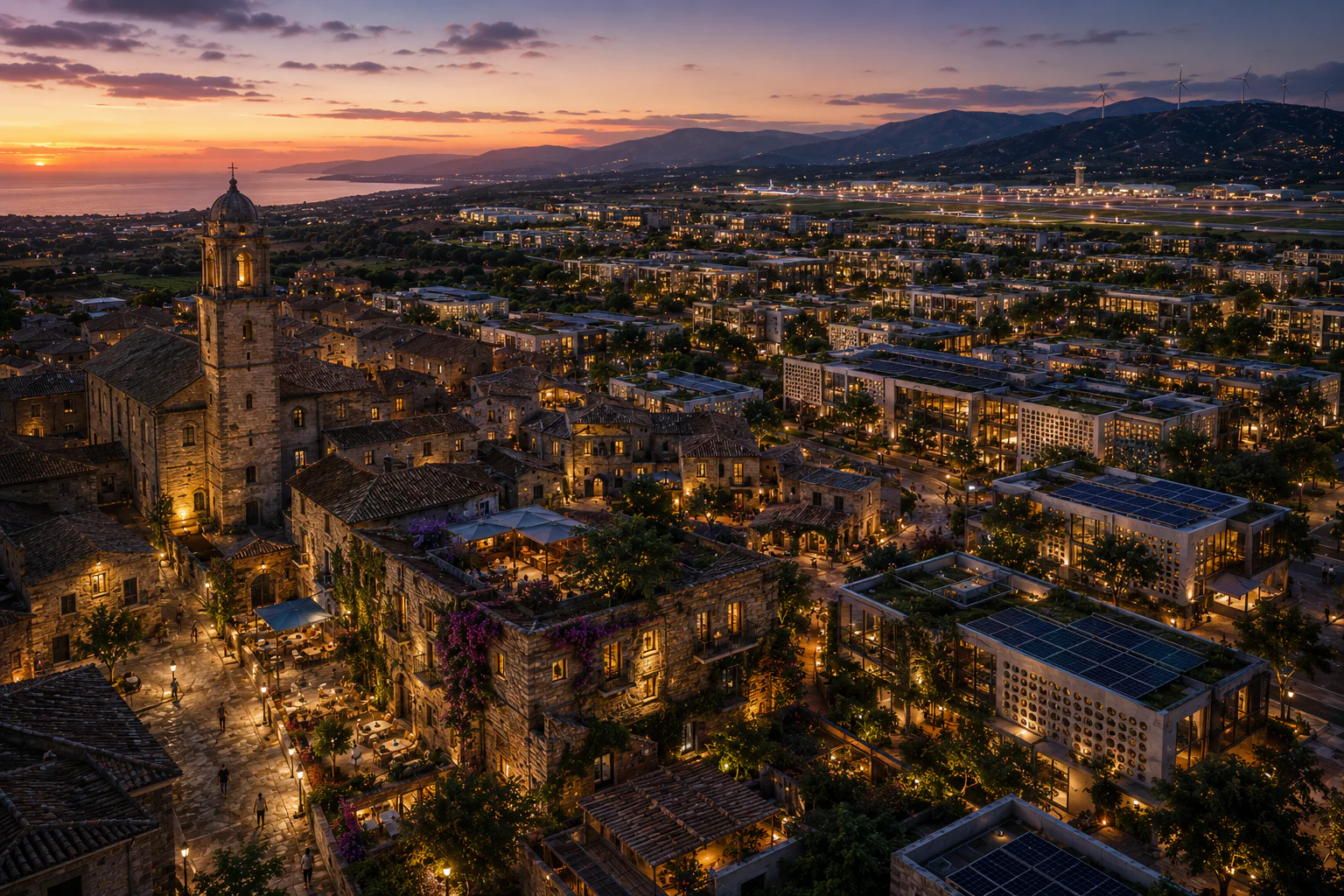
Heritage preserved. New industries embedded. Community thriving.
An ECAHLI Node is a self-sustaining green economic ecosystem — housing, services, industries, and verified environmental impact under a single governance and business model.
Developed on available land — greenfield or degraded — as a complete ECAHLI community built from day one. Brazil, Paraguay, and Kenya are all Stand-Alone deployments.
Designed for places like Spain, Italy, Portugal, and Latvia — where abandoned villages have architecture and heritage worth preserving. New is inserted between the historic, not replacing it.


Six proprietary systems, deployed in every Node — parameters adapted to local context, always measured and verified against the same institutional-grade framework.
Rapid, low-carbon construction with a large-format 3D printer and locally sourced hempcrete mix. Superior thermal performance, lower embodied carbon.
Community-wide renewable energy sized for full demand. Zero electricity cost to residents after ramp-up in the base model.
Converts 100% of organic waste into biogas and fertiliser. Zero organic waste to landfill, an added verified CO₂ offset layer.
Farms, orchards, greenhouses, and agri-processing for on-site food security and carbon-positive land management.
On-site recycling, greywater treatment, and rainwater capture, with real-time monitoring feeding the community IoT platform.
Real-time monitoring across energy, water, health, and agriculture. Automated ESG reporting for institutional investors.
Brazil Flagship — Proven and Verified. The ECAHLI Brazil flagship already demonstrates all six systems at operational scale, with quantified metrics across CO₂ offset, jobs created, residents housed, patients served, students educated, and hectares under regenerative management. Each new Node will publish its own Sustainability Impact page using the same methodology — enabling direct, like-for-like comparison across the global network.
The new complements the old. Production zones wrap around heritage streets. The economy returns.
ECAHLI does not make vague sustainability claims. Every Node measures outcomes across standard categories, using the same verification frameworks across all sites — comparable like assets in a managed portfolio.
Jobs by type and sector, wage levels against statutory minimums, formal contract coverage, and local procurement volume.
Residents housed, unit typology, build technology and embodied carbon, and effective monthly housing costs.
School capacity and enrolment, TVET throughput, scholarships, and graduate placement into formal employment.
Clinic or hospital beds, patients served annually, clinical services offered, and effective cost of access.
Net CO₂ offset verified to registry standard (Verra VCS, Gold Standard), renewable energy share, land under regenerative management.
Reporting against TNFD, PSC-G, and SDG frameworks. Community voting engagement and independent audit coverage.
Drawn from the ECAHLI Kisumu flagship base case — the first full deployment of the Node model at institutional scale. Every subsequent Node is designed to replicate and adapt this architecture.
Culture becomes economically viable again — the plaza is the social centre of a living, working community, not a heritage exhibit.
Structurally sound historic buildings and streetscapes are retained and made economically useful again.
Eco-buildings, production facilities, and services woven into the existing fabric of the village.
Young people who left for cities can return to formal, well-paid employment in the same village their grandparents built.
Workers, retirees, and remote professionals bring fresh energy into a community with the capacity to welcome them.
Every Node below replicates the same technology stack, governance model, and impact framework proven in Brazil and Kenya — adapted to local regulation, climate, and opportunity. 49 Nodes, 15 countries, pre-development and planning stage.
The African Flagship (Kisumu, Lake Victoria) plus 6 Regional Nodes, and the Tsavo, Tiwi Bay, and Malindi Development Nodes. Kisumu is the first full-scale institutional deployment: 16.5% base equity IRR, 2.80× Year 5 DSCR, 450 homes, 395 direct jobs, 200 TVET graduates annually. The benchmark every other Node is measured against.
3 Regional Nodes planned in each of Tanzania, Uganda, Rwanda, the DRC, and Central Africa — replicating the Kenya Regional Node model across the wider East and Central African region.
Brazil (Flagship + 2 Regional Nodes, Goiás State) anchors the region. Paraguay's Colmena District and Gran Chaco sites are already in early deployment. Uruguay, Peru, Ecuador, and Venezuela each have 2 Regional Nodes planned.
Portugal: ECAHLI Global Holdings Flagship + 2 Regional Nodes. Spain: 3 Regional Nodes + 3 Rural Integration Town Nodes. Italy: 2 Rural Integration Town Nodes — the model built specifically to repopulate abandoned rural towns and villages, detailed above.
Figures reflect ECAHLI's confirmed pre-development and planning-stage pipeline as of July 2026. Country-level detail is subject to change as each Node moves through local registration and permitting. See About ECAHLI → for the full platform overview.
"Every ECAHLI Node is built on the same technology backbone and measured through the same impact framework — so that investors and governments can compare Nodes like assets in a global portfolio, and communities can see exactly what they are delivering and for whom."
The industrial zone is not outside the village — it is woven into it, creating jobs inside the community it serves.
Kenya is the starting point — a multi-Node country platform anchored in Kisumu on Lake Victoria, with 6 further Regional Nodes and the Tsavo/Tiwi/Malindi Development Nodes confirmed alongside it. The Kisumu business plan is detailed, stress-tested, and investable now.
Eco-Community Alternative Housing Lifestyle Initiative — a living, working, self-sustainable community platform where people have everything they need to flourish, governed by the ECAHLI Community Handbook and built for a 50-year horizon.
Investor and partnership inquiries reach the founding team directly — no call centre, no delay.
© 2026 ECAHLI. All rights reserved.